Corporate Social Responsibility: The Complete Guide to Building a Better Business in 2025
Every business makes an impact on its employees, its community, the environment, and the broader economy. The question isn’t whether that impact exists. The question is whether it’s intentional.
Corporate social responsibility (CSR) is the practice of businesses taking deliberate, structured action to make that impact positive. It goes beyond writing a check to charity once a year. Done well, corporate social responsibility shapes how a company hires, how it treats its supply chain, how it manages its environmental footprint, and how it shows up in the communities where it operates.
This guide covers everything you need to know about corporate social responsibility in 2025 what it is, why it matters, how it works in practice, what the leading frameworks look like, and how businesses of any size can build a CSR strategy that creates real value rather than just good press.
What Is Corporate Social Responsibility?
Corporate social responsibility is a business model in which companies integrate social and environmental concerns into their operations and interactions with stakeholders . beyond what is legally required.
That last part matters. CSR is voluntary. A company that follows labor laws is meeting a legal baseline. A company that actively monitors its suppliers for fair labor practices, pays a living wage above the legal minimum, and invests in employee development is practicing corporate social responsibility.
The concept has evolved considerably over the past few decades. Early versions of CSR focused almost entirely on philanthropy corporations donating to charities or funding community projects as a form of goodwill. Modern corporate social responsibility is more strategic and more integrated. It ties business operations directly to social and environmental outcomes, recognizing that the two are inseparable over the long run.
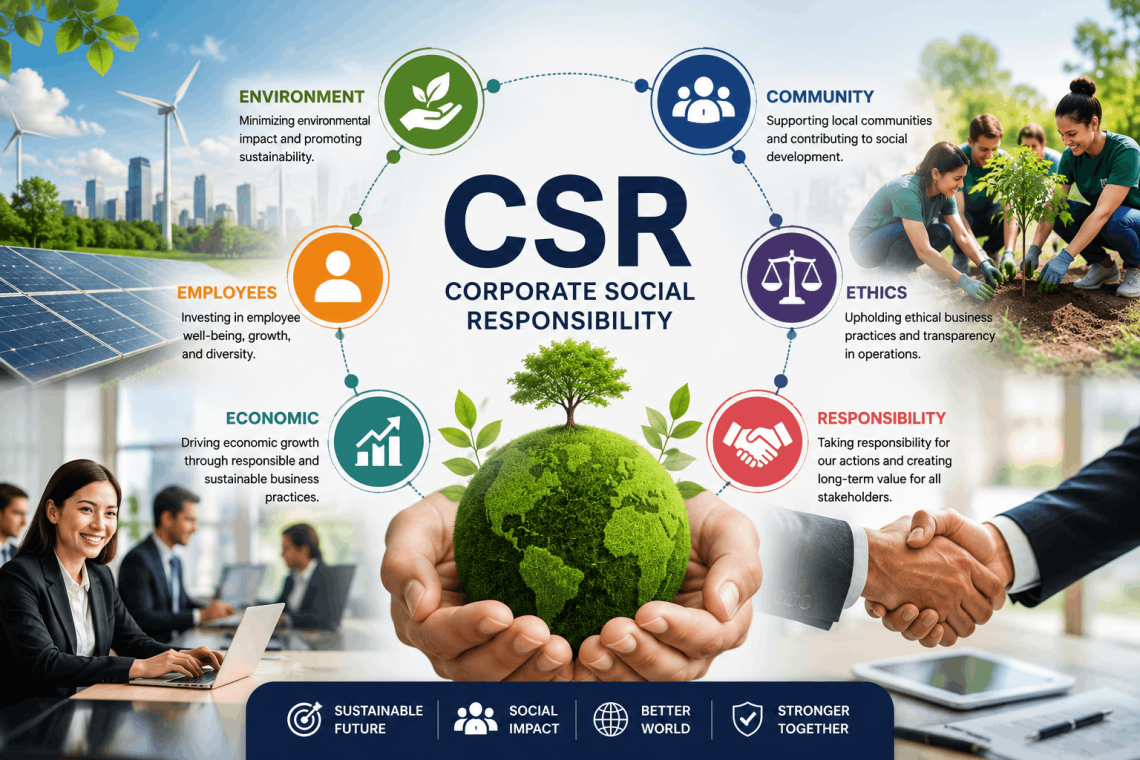
The Four Pillars of Corporate Social Responsibility
Most CSR frameworks organize business responsibility into four core areas:
- Environmental Responsibility How a company manages its impact on the natural world carbon emissions, waste, water use, supply chain sustainability, and product lifecycle management.
- Ethical Responsibility How a company conducts its business . fair treatment of employees, honesty with customers, anti-corruption practices, and ethical sourcing of materials.
- Philanthropic Responsibility How a company gives back . charitable donations, community investment, employee volunteering programs, and support for causes aligned with the company’s values.
- Economic Responsibility How a company ensures its financial practices serve broader goals fair wages, responsible investment, tax transparency, and long-term value creation over short-term profit extraction.
A strong corporate social responsibility strategy addresses all four pillars, not just the ones that generate the best headlines.
Why Corporate Social Responsibility Matters More Than Ever
Corporate social responsibility has moved from a nice-to-have to a business imperative. Several forces are driving this shift simultaneously.
H3: Consumer Expectations Have Changed
Today’s consumers particularly Millennials and Gen Z research the companies they buy from. They care about where products come from, how workers are treated, what a company’s environmental record looks like, and whether leadership statements match actual behavior.
Studies consistently show that a significant portion of consumers are willing to pay more for products from companies with strong CSR practices, and equally willing to boycott brands whose values conflict with their own.
This isn’t a fringe behavior. It’s mainstream consumer decision-making, and it’s reshaping purchasing patterns across industries from fashion to food to financial services.
Investors Are Paying Attention
Environmental, Social, and Governance (ESG) investing has grown from a niche approach to a mainstream investment framework. Institutional investors, pension funds, and individual investors increasingly factor a company’s CSR performance into their investment decisions.
Companies with poor environmental records, weak labor practices, or governance failures face higher capital costs and greater scrutiny. Companies with strong corporate social responsibility profiles attract investors who see sustainability as a proxy for long-term management quality.
The connection between CSR and investment access is direct: a company that cannot demonstrate responsible practices will find itself at a disadvantage when raising capital.
Employee Recruitment and Retention
Talented employees have options. They increasingly choose employers based on more than salary and benefits they want to work for organizations whose values match their own.
A genuine corporate social responsibility program is a recruitment tool. It signals to prospective employees that the company is serious about its impact on the world. It gives current employees a reason to feel pride in their work beyond their individual role.
High employee engagement driven by meaningful CSR programs also reduces turnover . a cost that is frequently underestimated. Replacing an employee typically costs between 50% and 200% of their annual salary when you factor in recruitment, onboarding, and lost productivity.
Regulatory Pressure Is Growing
Governments around the world are moving toward mandatory ESG disclosure requirements. The European Union’s Corporate Sustainability Reporting Directive (CSRD) requires large companies operating in the EU to disclose detailed sustainability information. Similar frameworks are developing in the United States, the UK, and across Asia-Pacific.
Companies that have already built robust corporate social responsibility programs and reporting practices are better positioned to meet these regulatory requirements without major disruption. Companies that have ignored CSR are facing an expensive retrofit.
Types of Corporate Social Responsibility Programs
Corporate social responsibility isn’t a single activity. It encompasses a wide range of programs, each targeting different aspects of a company’s impact.
Environmental CSR Programs
Environmental corporate social responsibility is one of the most visible and most actively tracked areas of CSR. Programs in this category include:
Carbon reduction commitments: Setting science-based targets to reduce greenhouse gas emissions across direct operations (Scope 1), purchased energy (Scope 2), and the value chain (Scope 3). Companies like Microsoft, Apple, and Unilever have made net-zero commitments with detailed roadmaps rather than vague pledges.
Renewable energy transition: Switching to solar, wind, or other renewable energy sources for company operations. Many companies now source 100% of their electricity from renewable sources as a baseline standard.
Waste reduction programs: Moving toward zero-waste manufacturing processes, eliminating single-use plastics from operations, implementing circular economy principles for product design and end-of-life management.
Sustainable sourcing: Ensuring raw materials are sourced from certified sustainable suppliers FSC certification for wood products, Rainforest Alliance certification for agricultural products, and responsible minerals sourcing in electronics supply chains.
Water stewardship: Monitoring and reducing water consumption, particularly in manufacturing operations in water-stressed regions.
Social CSR Programs
Social corporate social responsibility focuses on people employees, communities, and supply chain workers.
Fair labor practices: Paying living wages, providing safe working conditions, respecting workers’ rights to organize, and extending these expectations to suppliers and contractors not just direct employees.
Diversity, equity, and inclusion (DEI): Building workforces that reflect the communities companies serve, creating advancement opportunities for historically underrepresented groups, and ensuring pay equity across demographic groups.
Community investment: Funding local schools, community health programs, arts organizations, and economic development initiatives in the regions where a company operates.
Employee wellbeing programs: Mental health support, flexible work arrangements, paid parental leave, professional development funding, and employee assistance programs.
Human rights due diligence: Auditing supply chains for forced labor, child labor, and unsafe working conditions and taking corrective action when violations are found rather than simply dropping suppliers.
Governance CSR Programs
Governance corporate social responsibility addresses how a company is managed and held accountable.
Board diversity: Ensuring boards of directors include members with diverse backgrounds, experiences, and perspectives rather than networks of similar individuals who reinforce each other’s blind spots.
Executive pay transparency: Publishing the ratio of CEO pay to median worker pay, and explaining the rationale for executive compensation structures.
Anti-corruption policies: Implementing and enforcing zero-tolerance policies for bribery and corruption, with clear reporting channels for employees who witness violations.
Tax transparency: Disclosing tax practices and paying taxes in the jurisdictions where value is created, rather than using aggressive structures to shift profits to low-tax locations.
Data privacy and cybersecurity: Treating customer data as a responsibility rather than an asset to be monetized without consent.
Philanthropic CSR Programs
Philanthropy remains a meaningful component of corporate social responsibility, though it works best when it connects to a company’s core competencies and values rather than being disconnected charitable giving.
Matching gift programs: Matching employee donations to charitable organizations, which amplifies individual giving and signals company support for employee-chosen causes.
Cause-related marketing: Donating a percentage of sales to a relevant charity though this approach requires careful execution to avoid accusations of “causewashing.”
Pro bono services: Law firms providing free legal services to nonprofits, accounting firms auditing small charities, tech companies providing software to social enterprises.
Employee volunteering programs: Paid volunteer days, skill-based volunteering (using professional expertise rather than just physical labor), and board service at nonprofits.
Disaster relief and community emergency response: Committing company resources money, logistics, product donations, or employee expertise when communities face natural disasters or humanitarian crises.
How to Build a Corporate Social Responsibility Strategy
A CSR program built on good intentions but without structure tends to produce scattered initiatives, inflated claims, and limited actual impact. Building a genuine corporate social responsibility strategy requires the same discipline as any other business strategy.
Step 1 Conduct a Materiality Assessment
A materiality assessment identifies which social and environmental issues are most relevant to your specific business based on your industry, geography, supply chain, workforce, and stakeholder expectations.
A food company’s most material CSR issues might include agricultural water use, packaging waste, and farmer livelihoods in its supply chain. A software company’s material issues might center on data privacy, employee working conditions, and the energy consumption of its data centers.
Focusing your corporate social responsibility efforts on issues that are genuinely material to your business produces better outcomes than spreading resources across every possible cause. It also makes your reporting more credible to investors and stakeholders who understand your industry.
Step 2 Set Measurable Goals
Vague commitments “we care about the environment” or “we value our employees” . are not a CSR strategy. Credible corporate social responsibility programs set specific, measurable, time-bound targets:
- Reduce Scope 1 and Scope 2 carbon emissions by 50% by 2030
- Achieve pay equity across gender and ethnicity by 2026, with annual third-party audits
- Source 100% of key agricultural ingredients from certified sustainable farms by 2027
- Donate 1% of annual revenue to community organizations in operating regions
Measurable goals create accountability, enable progress tracking, and give stakeholders something concrete to evaluate
Step 3 Integrate CSR Into Core Operations
Corporate social responsibility that lives only in a dedicated CSR department is structurally limited. The most effective CSR programs integrate responsibility into core business decisions procurement, product design, human resources, finance, and marketing.
This means procurement teams consider supplier labor practices alongside price and quality. Product development teams factor environmental impact into design decisions from the start rather than retrofitting them later. Finance teams evaluate investments against ESG criteria as standard practice.
When CSR is integrated into operations rather than siloed, it produces systemic change rather than isolated programs.
Step 4 Engage Stakeholders
The people most affected by your corporate social responsibility decisions employees, community members, suppliers, customers should have input into those decisions.
Stakeholder engagement can take many forms: employee surveys and focus groups on workplace practices, community advisory panels for local investment decisions, supplier roundtables to discuss sourcing standards, and customer research on product sustainability preferences.
Engaging stakeholders produces better CSR programs because it surfaces issues and opportunities that internal teams can miss. It also builds trust people who have been consulted are more likely to believe a company’s CSR commitments are genuine.
Step 5 Report Transparently and Consistently
Publishing an annual CSR or sustainability report is now standard practice for companies that take corporate social responsibility seriously. These reports communicate progress against stated goals, acknowledge where targets were missed and explain why, and outline plans for the coming year.
Leading CSR reporting frameworks include:
GRI (Global Reporting Initiative): The most widely used framework globally, covering economic, environmental, and social performance.
SASB (Sustainability Accounting Standards Board): Industry-specific standards that identify the sustainability issues most relevant to each sector.
TCFD (Task Force on Climate-related Financial Disclosures): A framework specifically focused on climate risk disclosure for investors.
UN Sustainable Development Goals (SDGs): Many companies map their CSR activities to the 17 SDGs to connect their efforts to a globally recognized framework.
Consistent, honest reporting builds credibility over time. Companies that only report their successes and bury their failures will eventually face scrutiny that undermines everything they’ve built.
Corporate Social Responsibility Examples From Leading Companies
Learning from companies that have built mature corporate social responsibility programs offers practical insight into what works.
Patagonia environmental Commitment as Business Identity
Patagonia has built its entire brand around environmental corporate social responsibility. The company donates 1% of sales to environmental causes, uses recycled materials in its products, repairs clothing to extend product life, and has pledged its entire company to the fight against climate change legally binding the organization to donate all profits not reinvested in the business to environmental causes.
What makes Patagonia’s CSR distinctive is that it’s not a marketing layer over a conventional business. Environmental responsibility shapes every core business decision, from product design to supply chain management to political advocacy.
Microsoft Carbon Negative Commitment
Microsoft made headlines with its commitment to be carbon negative by 2030 and to remove all historical carbon emissions the company has ever produced by 2050. This goes well beyond carbon neutrality it’s a commitment to give back more than the company has ever taken.
Microsoft’s approach to environmental corporate social responsibility is notable for its specificity: detailed science-based targets, investment in carbon removal technology, transparency about the challenges involved, and accountability mechanisms built into executive compensation.
H3: Ben & Jerry’s Social Advocacy as CSR
Ben & Jerry’s has long used its platform and resources to advocate for social causes . criminal justice reform, voting rights, LGBTQ+ equality, and climate justice. The company’s corporate social responsibility approach links its business practices (Fairtrade certified, non-GMO, employee ownership model) with active public advocacy on policy issues.
This approach is more controversial than conventional philanthropy some consumers appreciate it, others don’t. But it demonstrates that genuine CSR sometimes means taking positions rather than playing it safe.
Common Corporate Social Responsibility Mistakes to Avoid
Understanding what doesn’t work in corporate social responsibility is as important as knowing what does.
Greenwashing
Greenwashing means making environmental claims that are exaggerated, misleading, or entirely unsupported by actual practices. Companies that market products as “eco-friendly” without evidence, or announce net-zero commitments without credible plans, are greenwashing.
The consequences are serious. Regulatory bodies in the EU, US, and UK are increasingly scrutinizing environmental marketing claims. Consumer backlash when greenwashing is exposed can be severe and lasting. Investors who discover inflated ESG claims face legal exposure.
Genuine corporate social responsibility requires honest communication . including about what you haven’t achieved yet.
Treating CSR as a PR Exercise
Corporate social responsibility programs designed primarily to generate positive press rather than produce real outcomes tend to be shallow, inconsistent, and ultimately counterproductive. When scrutiny comes and it does programs built for optics rather than impact don’t hold up.
The test is whether a company would pursue its CSR activities even if no one was watching. If the answer is no, the program is marketing rather than genuine responsibility.
Ignoring Internal Issues While Funding External Causes
A company that donates generously to community causes while underpaying its own employees, ignoring workplace safety, or allowing a toxic culture to persist is practicing corporate social responsibility in reverse. External generosity doesn’t offset internal harm.
Authentic CSR starts with how a company treats the people directly connected to its operations employees first, then community, then the broader world.
Setting Goals Without Accountability
Announcing ambitious CSR targets without creating accountability mechanisms independent verification, board oversight, executive compensation linkage produces targets that quietly fade when they become inconvenient.
Strong corporate social responsibility programs tie progress to real consequences: executive bonuses that depend partly on CSR metrics, third-party audits of reported data, and board committees with specific oversight responsibility for sustainability performance.
Corporate Social Responsibility and Small Business
Corporate social responsibility is not exclusively the domain of large corporations. Small and medium-sized businesses can build meaningful CSR practices scaled to their resources and community context.
Starting Small but Starting Genuine
A small business doesn’t need a dedicated sustainability team or an annual CSR report to practice genuine responsibility. Starting with one or two areas where the business can make a real difference switching to a local supplier, implementing an employee matching gift program, reducing packaging waste produces more credible outcomes than trying to cover every CSR category at once.
The Local Advantage
Small businesses often have a natural community connection that large corporations work hard to replicate. A local business that is genuinely embedded in its community, employs local people fairly, sources from local suppliers, and supports local causes is practicing corporate social responsibility in the most direct way possible.
This local authenticity is a genuine competitive advantage. It’s also harder for large competitors to copy than any product feature or price point.
Employee Involvement in CSR Decisions
Small businesses have the advantage of being able to involve all or most of their employees in deciding where CSR energy and resources should go. This produces better buy-in, better ideas, and a more genuine connection between the company’s values and the values of the people who work there.
Measuring the Business Impact of Corporate Social Responsibility
The question every skeptical executive eventually asks: does corporate social responsibility actually improve business results? The evidence is substantial.
Brand value: Companies with strong CSR reputations consistently score higher on brand trust and brand preference metrics. Trust is one of the most valuable and hardest-to-build business assets and CSR is one of the most reliable ways to accumulate it.
Customer loyalty: CSR-aligned customers tend to be more loyal and less price-sensitive than customers who have no values connection to a brand. Loyal customers have higher lifetime value and lower acquisition costs.
Talent quality: Companies known for genuine CSR attract more qualified applicants and retain employees at higher rates. The compounding effect of consistently hiring and keeping good people is one of the most durable competitive advantages in business.
Risk reduction: Companies with strong environmental and social practices face fewer regulatory penalties, fewer supply chain disruptions from unethical suppliers, and fewer reputational crises from practices that were hidden until they weren’t. Risk reduction has real economic value, even though it’s harder to measure than revenue.
Access to capital: ESG-aligned investors represent a growing share of global capital. Companies with credible corporate social responsibility programs expand their investor base and often achieve lower costs of capital as a result.
Building a Business That Lasts
Corporate social responsibility is ultimately about building a business that earns the right to keep operating one that creates enough value for enough stakeholders that society has a genuine interest in its success.
Companies that treat responsibility as a constraint on profit miss the point entirely. The most successful businesses of the coming decades will be the ones that figured out how to make doing good and doing well the same thing where the interests of employees, communities, the environment, and shareholders point in the same direction because the business was designed that way from the start.
That’s the real case for corporate social responsibility. Not reputation management. Not regulatory compliance. A better, more resilient, more trusted business one that earns loyalty because it deserves it.
The businesses that get this right early will look back on it as one of the most important strategic decisions they ever made.