RemoteJobsFinder: Your Complete Guide to Building a Better Remote Career
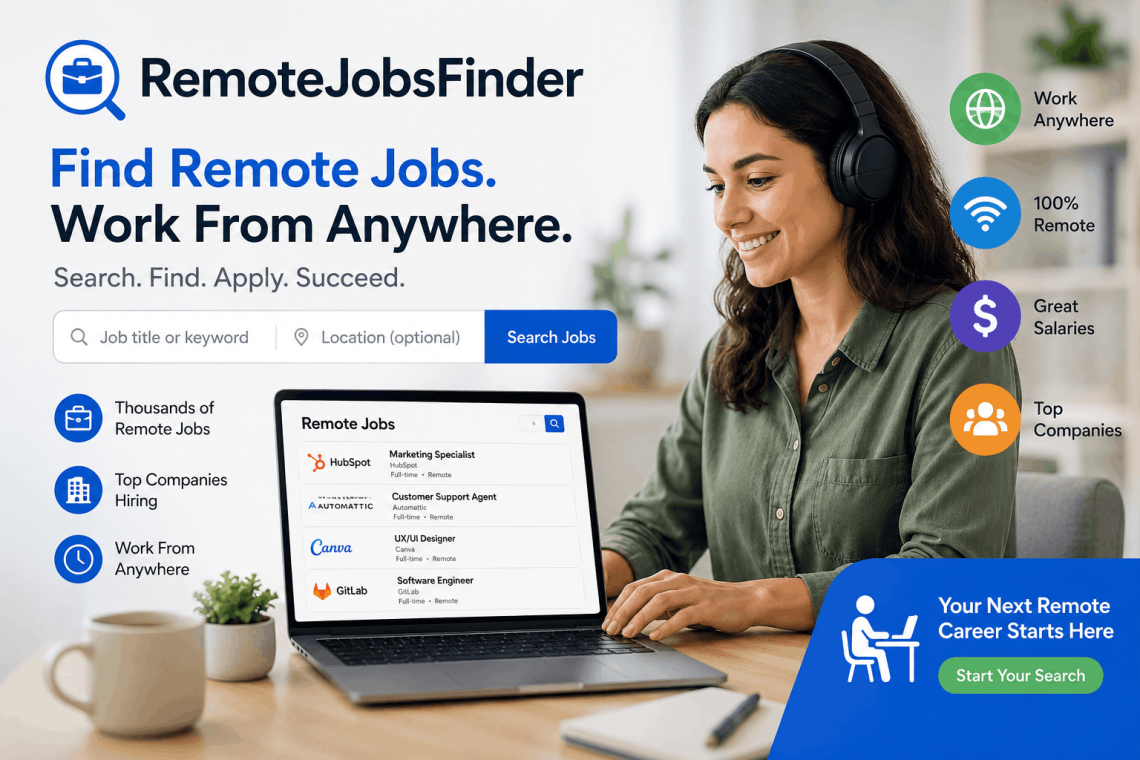
Whether you are just starting out or have been working from home for years, finding the right remote opportunities can feel overwhelming. Thousands of job boards exist, but most are cluttered with outdated listings, low-paying gigs, or roles that are not truly remote. That is exactly where RemoteJobsFinder steps in a purpose-built platform designed to connect serious remote job seekers with legitimate, high-quality opportunities across every industry.
This guide covers everything you need to know about using RemoteJobsFinder effectively, building a standout remote career profile, acing remote interviews, and staying ahead in a competitive market.
What Is RemoteJobsFinder?
RemoteJobsFinder is a specialized remote job search platformhttps://seriocus.com/ that curates verified remote positions from companies worldwide. Unlike general job boards that mix on-site and hybrid roles into the same pool, RemoteJobsFinder focuses exclusively on positions that offer genuine location flexibility whether fully remote, async-first, or globally distributed.
The platform attracts job seekers ranging from entry-level candidates looking for their first work-from-home role to experienced professionals targeting senior remote positions at top-tier companies.
Why RemoteJobsFinder Stands Out from General Job Boards
Most job boards were not built with remote workers in mind. They often tag hybrid or occasional work-from-home arrangements as “remote” which wastes your time and creates false expectations.
RemoteJobsFinder filters this noise by:
- Verifying employer legitimacy before listings go live
- Categorizing roles by true remote type (fully remote, remote-first, async)
- Organizing opportunities by time zone compatibility
- Highlighting companies with proven remote cultures
This level of specificity saves job seekers hours of filtering and dramatically increases the quality of applications submitted.
Who Should Use RemoteJobsFinder?
RemoteJobsFinder is built for a broad range of professionals. You do not need to be a software developer to benefit from it. The platform actively features roles across:
- Technology software engineering, product management, DevOps, QA
- Marketing content strategy, SEO, paid media, social media management
- Design UI/UX, graphic design, brand identity, motion graphics
- Customer Support technical support, account management, customer success
- Finance & Accounting bookkeeping, financial analysis, CFO advisory
- Education & Training instructional design, online tutoring, curriculum development
- Healthcare telehealth support, medical billing, health coaching
- Writing & Communications copywriting, technical writing, PR, editing
If your work can be done on a laptop with an internet connection, there is very likely a listing on RemoteJobsFinder that fits your background.
How to Set Up a Winning Profile on RemoteJobsFinder
Your profile is the first impression employers get. A half-finished or generic profile gets scrolled past. Here is how to build one that gets noticed.
Write a Specific, Keyword-Rich Headline
Generic headlines like “Marketing Professional” or “Experienced Developer” do not tell employers anything useful. Instead, write headlines that communicate your specialty and remote readiness:
Weak: Marketing Professional Open to Remote Work
Strong: B2B Content Strategist | SaaS Brands | Fully Remote Since 2019
The strong version tells a hiring manager exactly what you do, who you do it for, and that you are experienced with remote work all in one line.
Highlight Remote-Specific Skills
Working remotely requires a distinct skill set beyond your core profession. Employers on RemoteJobsFinder specifically look for candidates who can demonstrate:
- Async communication Do you write clearly and proactively in tools like Slack or Notion?
- Self-direction Can you manage your own schedule and priorities without supervision?
- Documentation habits Do you write things down so teammates in other time zones can stay aligned?
- Video presence Are you comfortable and professional on camera for calls?
Include concrete examples of these in your profile summary. Do not just say you are a “strong communicator” mention that you managed a distributed team across four time zones, or that you reduced project delays by implementing async standup updates.
List Your Tools and Tech Stack
Remote employers care deeply about tool compatibility. List every platform you are proficient
with, such as:
- Project Management: Asana, Jira, Linear, Monday, Notion
- Communication: Slack, Zoom, Loom, Google Meet
- Design: Figma, Adobe Creative Suite, Canva
- Development: GitHub, GitLab, VS Code, Docker
- Finance: QuickBooks, Xero, NetSuite
Even listing “proficient in Loom for async video updates” signals remote-readiness to experienced hiring teams.
Searching for Jobs Effectively on RemoteJobsFinder
Knowing how to search is just as important as having a great profile. Here are strategies that get results.
H3: Use Filters Strategically
RemoteJobsFinder offers filters most general boards lack. Take full advantage of:
- Time zone filter If you are based in South Asia or Eastern Europe, filter for companies that accept overlap with your working hours
- Company size Startups and large enterprises have different remote cultures; choose what fits you
- Salary range Do not waste time on roles that will not meet your target
- Date posted Focus on listings from the last 7–14 days to avoid stale postings
Set Up Job Alerts
Do not rely on logging in every day. Set up email or push alerts for your top keyword combinations. For example:
- “UX Designer | Americas time zone | $90k–$130k”
- “Python Developer | Fully Remote | Series B startup”
When a matching role gets posted, you are notified immediately often before the listing gets widely shared on social media. Being among the first 10–20 applicants puts you in a significantly stronger position.
Research Companies Before Applying
RemoteJobsFinder often links to company profiles that show you their remote work policy, team size, and employee reviews. Before applying, spend five minutes researching:
- Is the company remote-first or remote-friendly? (There is a big difference)
- What does their async communication culture look like?
- Do they have a distributed team, or is most of the company in one office?
This research also helps you personalize your cover letter, which dramatically improves response rates.
Writing Cover Letters That Actually Get Read
Most cover letters on remote job boards are copy-paste disasters. Hiring managers can spot them instantly. Here is a structure that works:
The 4Part Remote Cover Letter
- Specific opening (2–3 sentences) Reference the exact role, company name, and one specific thing that caught your attention a blog post they published, a product feature you use, or a mission statement that matches your values.
- Your relevant remote experience (3–4 sentences) Talk about your most relevant achievement and connect it to their needs. If they want a content writer who can manage editorial calendars independently, mention that you maintained a 20-post-per-month blog schedule for a fully distributed company with zero missed deadlines.
- Remote work proof (2–3 sentences) Tell them how you work remotely. Mention specific tools, how you handle time zone differences, or how you document your work. This is where most candidates miss an opportunity.
- Clear, confident close (1–2 sentences) Ask for the next step. Do not beg. “I would welcome the chance to discuss how I can contribute to [Company]’s growth happy to share work samples at your convenience.”
Preparing for Remote Interviews
Landing an interview through RemoteJobsFinder is only half the battle. Remote interviews have their own dynamics.
Test Your Setup Before Every Call
Technical problems during an interview create a bad first impression that is hard to recover from. At least 30 minutes before any scheduled interview:
- Test your camera, microphone, and internet speed
- Check your lighting (face a window or use a ring light avoid being backlit)
- Confirm your background is clean or use a professional virtual background
- Have a backup plan if your primary connection fails (mobile hotspot)
Show Async Thinking in Your Answers
Remote employers want to hire people who can operate without constant hand-holding. When answering behavioral questions, frame your answers to show your async mindset:
Interviewer: “Tell me about a time you managed a complex project.”
Weak answer: “I held weekly meetings and kept the team aligned.”
Strong answer: “I built a shared Notion workspace where every decision, blocker, and deadline was documented. Team members in three different countries could check progress without scheduling a meeting. We delivered two weeks ahead of schedule.”
The second answer shows remote-specific competency, not just general project management skill.
Prepare Smart Questions for Them
The questions you ask reveal how seriously you understand remote work. Ask things like:
- “How does your team handle knowledge transfer for new hires who are fully remote?”
- “What does a typical async workday look like for someone in this role?”
- “How does leadership support remote employees’ professional development?”
These questions demonstrate that you think about the real challenges of distributed teams which immediately sets you apart from candidates who just ask about salary and benefits.
Salary Negotiation for Remote Roles
Remote work has shifted salary negotiation in interesting ways. Some companies offer location-adjusted pay, while others maintain flat global salaries. RemoteJobsFinder listings often include salary ranges, which gives you a strong negotiation starting point.
Know Your Market Rate
Use the salary data from RemoteJobsFinder listings combined with data from platforms like Glassdoor, Levels.fyi, and LinkedIn Salary to triangulate your market rate. When negotiating:
- Anchor with a specific number, not a range (“I am targeting $95,000” is stronger than “somewhere between $85k and $95k”)
- Factor in benefits, equity, home office stipends, and async flexibility into your total compensation evaluation
- If a company offers location-based pay, present data showing that remote workers deliver equivalent or higher productivity
Understand Geographic Pay Policies
Before negotiating, clarify the company’s pay philosophy:
- Location-agnostic: Same salary regardless of where you live most favorable for candidates in lower cost-of-living areas
- Location-based tiers: Salary adjusts to your city or country know which tier you fall into
- Global benchmark: Pay set to a percentage of US market rate common at international startups
RemoteJobsFinder company profiles often include information about pay philosophy, so check before entering negotiations.
Building Long-Term Success in Your Remote Career
Getting hired is the first step. Thriving in a remote role over the long term requires intentional habits.
Create Visible Work Output
Remote careers suffer when contributions go unnoticed. Make your work visible by:
- Writing weekly summaries of what you completed and what is coming next
- Sharing wins publicly in team channels (not to boast, but to keep stakeholders informed)
- Documenting processes you improve so others benefit and so leadership sees your impact
Invest in Your Home Office
Your environment directly affects your performance and your professional image on video calls. Prioritize:
- A reliable, fast internet connection (wired ethernet beats WiFi for stability)
- A quality microphone audio matters more than video quality
- Ergonomic furniture to protect your health over long working hours
- Dedicated workspace separate from living areas to maintain work-life boundaries
Stay Connected to Your Industry
Remote work can create isolation if you are not proactive. Use RemoteJobsFinder not just for job searches but as a window into where your industry is moving. Follow companies that consistently post interesting roles they signal where growth is happening.
Beyond the platform, attend virtual conferences, contribute to online communities, and maintain relationships with former colleagues. Remote careers are sustained by strong networks just as much as in-person careers are.
Common Mistakes Remote Job Seekers Make (and How to Avoid Them)
Even strong candidates make avoidable errors on RemoteJobsFinder and similar platforms. Watch out for:
Applying to too many roles without customization. Spray-and-pray approaches have an extremely low success rate. Ten targeted, customized applications outperform one hundred generic ones every time.
Ignoring time zone requirements. If a company lists “Americas time zone required” and you are 11 hours away with no overlap, applying wastes everyone’s time. Filter appropriately.
Underestimating async writing skills. If your profile summary, cover letter, or application responses have grammar issues or vague language, it signals poor written communication . the most critical skill in remote work.
Failing to follow up. A brief, professional follow-up email five to seven days after applying shows initiative and genuine interest. Keep it short: one paragraph, no desperation.