Remote Jobs IO: Your Complete Guide to Better Career Success
The remote work revolution did not slow down it matured. What started as a pandemic-driven experiment has become a permanent feature of the global job market, and the platforms connecting workers to distributed opportunities have grown sharper and more specialized alongside it. Remote Jobs IO stands at the front of that shift, offering job seekers a focused, curated experience that cuts through the noise of generalist job boards and puts genuinely remote opportunities front and center.
Whether you are making the jump from office life for the first time, returning to the workforce with remote work as a non-negotiable, or a seasoned remote professional looking to level up your career, this guide walks you through everything you need to know . from setting up your job search on Remote Jobs IO to negotiating your offer and building a career that lasts.
What Is Remote Jobs IO?
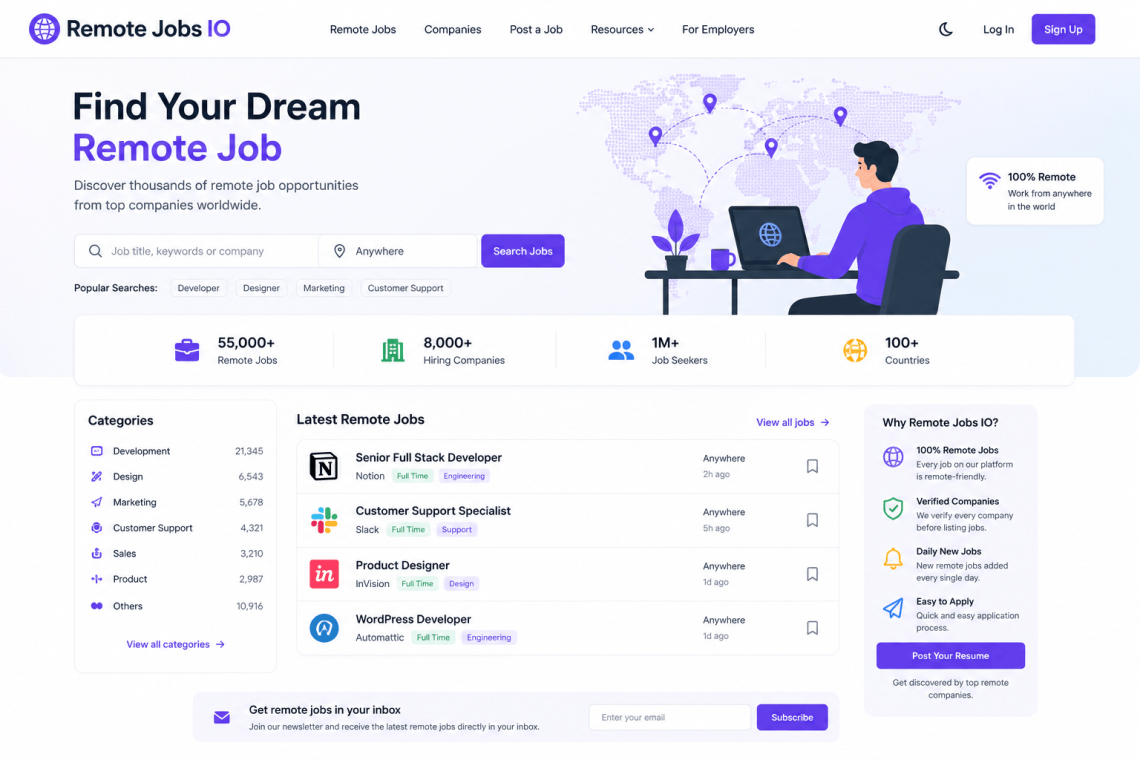
Remote Jobs IO is a dedicated remote job search platform built specifically for professionals who want location-independent work. Unlike general job boards that treat “remote” as one filter among dozens, Remote Jobs IO exists solely to connect job seekers with employers who have fully committed to distributed teams.
The platform aggregates and curates remote job listings across a wide range of industries and experience levels, making it a reliable starting point for anyone serious about finding remote work. Employers listing on Remote Jobs IO signal from the outset that they are looking for remote candidates not office hires who occasionally work from home.
How Remote Jobs IO Differs from General Job Boards
The distinction matters more than it might seem. On a general job board, searching for “remote” yields a mix of fully remote roles, hybrid arrangements, “remote possible” situations, and sometimes purely on-site roles with the remote tag applied by mistake. Filtering through this takes hours and breeds frustration.
Remote Jobs IO eliminates that friction. Every listing on the platform has been placed there by an employer actively seeking remote workers. This saves job seekers significant time and produces a higher-quality pool of applications which ultimately means faster, more relevant results.
Who Remote Jobs IO Is Built For
Remote Jobs IO serves a broad professional community. You do not need to be in tech to benefit from it.
The platform regularly features opportunities across:
- Software Development frontend, backend, full-stack, mobile, DevOps, cloud engineering
- Product and Project Management product owners, scrum masters, program managers
- Design UI/UX designers, brand designers, motion graphics, product designers
- Marketing content marketing, SEO specialists, paid acquisition, email marketing
- Sales account executives, SDRs, business development, partnerships
- Customer Success and Support onboarding specialists, technical support, account managers
- Finance and Operations controllers, FP&A analysts, operations managers, bookkeepers
- Writing and Content technical writers, copywriters, editors, content strategists
- HR and Recruiting talent acquisition, people operations, HR business partners
- Legal and Compliance contract specialists, compliance analysts, paralegals
If your work does not require physical presence, Remote Jobs IO likely has a listing that fits.
Setting Up Your Job Search on Remote Jobs IO
Getting the most out of Remote Jobs IO starts with how you approach the platform. A few deliberate setup steps make a measurable difference in the quality of results you see.
H3: Define Your Remote Work Non-Negotiables First
Before searching, get clear on what “remote” actually means for you. These are the parameters worth defining upfront:
Time zone requirements: Are you open to working on US hours if you are based elsewhere? Can you do overlap with European teams? Time zone compatibility is one of the most overlooked factors in remote job searching, and it becomes a major issue if mismatched.
Fully remote vs. remote-first: A fully remote company has no offices everyone works remotely. A remote-first company has offices but treats remote workers as first-class participants. Both are valid; they just have different cultures and expectations.
Async vs. real-time work: Some remote roles are heavily meeting-driven. Others operate almost entirely asynchronously. Know your preference before you apply it affects your day-to-day experience profoundly.
Contract vs. full-time: Remote Jobs IO lists both full-time roles and contract or freelance positions. Decide in advance which you are looking for to avoid wasted applications.
Use Specific Search Queries
Broad searches return broad results. Specific queries surface the opportunities most relevant to you. Instead of searching “marketing,” try:
- “SEO manager SaaS”
- “content strategist B2B remote”
- “email marketing specialist e-commerce”
The more precise your query, the more targeted your results and the more focused your application process.
Set Up Job Alerts
Remote Jobs IO, like most modern job platforms, allows you to create saved searches with alert notifications. This is one of the highest-leverage actions you can take in a remote job search.
When a new role matching your criteria gets posted, you receive a notification often within hours of the listing going live. Being among the first applicants on a strong posting dramatically improves your chances. Many hiring managers admit they form first impressions of applicant pools within the first 20–30 applications received.
Building a Profile That Gets Noticed
Your profile on Remote Jobs IO and the application materials you pair it with are doing sales work on your behalf while you sleep. Treat them accordingly.
Write a Remote-Optimized Professional Summary
A professional summary written for a remote audience differs from a standard one. Hiring managers on remote-focused platforms are looking for specific signals beyond your job titles and skills.
Your summary should answer these questions for the reader:
- What do you do, at what level, and for what type of company?
- How long have you been working remotely, and how have you made it work?
- What communication and collaboration tools are you fluent in?
- What kind of remote culture do you thrive in?
A strong remote-focused summary might look like this:
“Growth marketer with eight years of experience driving user acquisition for B2B SaaS companies. Fully remote since 2018, having built and led distributed teams across North America and Europe. Proficient in async-first communication, using Notion for documentation and Loom for video updates to keep stakeholders aligned without unnecessary meetings. Comfortable owning full campaign cycles independently and presenting results directly to founders and C-suite.”
This summary communicates expertise, remote experience, tool fluency, and work style four things remote employers care about most.
List Your Remote Work Tools Explicitly
Remote employers want to know that you will not need hand-holding on the operational side of distributed work. Be specific about every platform you use regularly:
Communication: Slack, Microsoft Teams, Discord, Loom, Zoom, Google Meet
Project Management: Notion, Asana, Jira, Linear, Monday.com, ClickUp, Trello
Documentation: Confluence, Notion, Google Docs, Coda
Design Collaboration: Figma, Miro, FigJam, Canva
Development: GitHub, GitLab, VS Code, Docker, CI/CD pipelines
Finance/Admin: QuickBooks, Xero, Expensify, Bill.com
Even listing comfort with video communication tools like Loom which many people overlook sends a strong signal of async-readiness.
Quantify Your Remote Achievements
Remote hiring managers are skeptical by default they cannot shake your hand, read your body language, or observe your work habits in person. Numbers cut through that skepticism.
Compare these two descriptions of the same work:
Vague; Managed social media accounts and grew our following.
Quantified: Grew LinkedIn following from 4,200 to 31,000 in 14 months through an organic content strategy, generating 280 inbound leads per quarter.
The second version tells a story the reader can trust. Apply this principle to every significant achievement on your profile.
Writing Applications That Stand Out on Remote Jobs IO
The remote job market is competitive. There are more qualified applicants than open roles for the most desirable positions. Your application needs to do more than check boxes it needs to tell a compelling story.
Customize Every Application
This is the single most impactful thing you can do to improve your response rate. A customized application demonstrates genuine interest and shows that you read the job description carefully two things that immediately separate you from applicants who send generic materials.
For every application, customize:
- Your cover letter opening reference the specific role, company name, and one detail about the company that attracted you
- Your skill emphasis match the skills you highlight to those specifically mentioned in the job description
- Your examples use achievements from your background that mirror the scope and type of work described in the role
This level of personalization takes more time per application, but it dramatically improves your hit rate. Ten customized applications will outperform one hundred generic ones without exception.
The Structure of a Strong Remote Cover Letter
A cover letter for a remote role should follow a clear, concise structure:
Opening paragraph: Name the role, the company, and one specific reason you are interested. Make it personal and concrete not a generic compliment.
Second paragraph: Describe your most relevant achievement. Use numbers. Connect it directly to what the employer is trying to accomplish.
Third paragraph: Address your remote work experience and style. How do you communicate across time zones? How do you manage your work without in-person supervision? What systems do you use to stay aligned with distributed teams?
Closing: Request the next step directly and confidently. “I would welcome the chance to discuss how my background fits your team’s needs happy to connect at your convenience.”
Keep the whole letter to four short paragraphs. Hiring managers at fast-moving remote companies rarely read long cover letters in full.
Follow Up Strategically
Following up after an application shows initiative a quality remote employers prize. Send a brief, professional follow-up email five to seven business days after submitting your application if you have not heard back.
Keep it to three sentences maximum:
- Confirm you applied for the specific role
- Reiterate your genuine interest in one sentence
- Ask if there is any additional information you can provide
Do not apologize for following up. You are showing professional initiative, not being a nuisance.
Preparing for Remote Job Interviews
Landing an interview from Remote Jobs IO is a meaningful milestone. Now the work shifts from application to performance.
Test Your Technical Setup Before Every Interview
A technical failure in the first five minutes of a remote interview is an extremely difficult first impression to recover from. Run a full technical check at least 30 minutes before each call:
- Camera: Make sure you are well-lit from the front, not backlit. Face a window or use a ring light.
- Microphone: Use a dedicated USB microphone or a quality headset laptop microphones rarely sound professional.
- Internet: Run a speed test. If possible, use a wired ethernet connection rather than WiFi for stability.
- Background: Use a clean physical background or a professional virtual background.
- Backup plan: Know what you will do if your primary connection fails (mobile hotspot, another device).
These five checks take ten minutes and can save an otherwise strong interview from derailing.
Show Async-First Thinking in Your Answers
Remote employers are not just evaluating your skills they are evaluating how you think about distributed work. Weave async-first thinking into your behavioral answers.
When asked about project management, instead of describing meeting-heavy coordination, describe how you structured documentation, used written updates to replace status meetings, or built Notion wikis that kept stakeholders informed without scheduling calls.
When asked about communication challenges, describe how you solved a time zone conflict with a well-documented decision log, an async video update, or a structured weekly written digest not by scheduling more calls.
These answers show that you think like an experienced remote worker, not just someone who works from home.
Ask Questions That Signal Remote Sophistication
The questions you ask at the end of an interview reveal how seriously you understand remote work. Go beyond salary and benefits with questions like:
- “How does your team handle knowledge transfer when someone new joins fully remotely?”
- “What does async communication look like on a typical week for this role?”
- “How does leadership ensure remote employees have visibility into company direction and decisions?”
- “How do you handle performance feedback in a distributed team?”
These questions demonstrate that you have considered the real operational challenges of remote work and that you are ready to participate in solving them, not just benefiting from the arrangement.
Salary Negotiation for Remote Roles
Remote work has made salary negotiation both simpler and more complex. Simpler because many remote-first companies publish salary bands. More complex because geographic pay policies vary widely.
Research Your Market Rate Thoroughly
Before entering any negotiation, build a clear picture of your market rate using multiple data sources. Remote Jobs IO listings themselves are valuable here many include salary ranges, and browsing comparable roles gives you a real-time picture of what companies are paying.
Supplement this with data from Glassdoor, Levels.fyi (for tech roles), LinkedIn Salary, and Payscale. When you have data from four or five sources, you can walk into a negotiation with a defensible number not just a gut feeling.
Understand Geographic Pay Policies
Remote companies handle location-based pay in three distinct ways:
Location-agnostic pay: The company pays the same salary regardless of where you live. This is most favorable for workers in lower cost-of-living areas and is common at fully distributed companies.
Tiered geographic pay: The company adjusts salary based on your city, region, or country. Know which tier applies to you before you negotiate otherwise you may anchor to a number that the employer intends for a different tier.
Global benchmark pay: The company pays a percentage of a US market benchmark globally. Common at international startups, this approach is transparent but may result in below-market pay in certain regions.
Ask directly about pay philosophy in the first or second interview stage. Companies with clear policies will answer without hesitation. Vague answers about this topic are a yellow flag worth noting.
Negotiate the Full Package
Remote roles often include non-salary benefits that carry real financial value. Factor these into your negotiation:
- Home office stipend: Some companies offer $500–$3,000+ for setting up a home workspace
- Internet reimbursement: Monthly allowances for broadband costs
- Equipment: Laptop, monitor, peripherals provided by the company
- Co-working allowance: Monthly credits for using a co-working space
- Learning and development budget: Annual allowances for courses, conferences, or books
- Async-first schedule: The ability to set your own hours has genuine lifestyle value worth considering in total compensation
When negotiating salary, always anchor with a specific number. “I am targeting $105,000 based on my research and experience” is more effective than “somewhere in the $90,000–$110,000 range.” A range invites the employer to offer the lower end.
Building a Long-Term Remote Career
Getting hired is the beginning. Sustaining and growing a remote career over years requires a different set of habits than traditional office work.
Make Your Work Visible
The biggest career risk in remote work is being good at your job while being invisible to the people who make promotion and compensation decisions. Counteract this deliberately:
- Write weekly or bi-weekly summaries of what you completed, what is in progress, and what is blocked
- Share wins publicly in team channels not to self-promote, but to keep stakeholders informed
- Document processes you improve and share them where the team can benefit
- Volunteer for high-visibility projects that get you in front of senior leadership
Visibility in a remote environment is not automatic. It has to be built intentionally.
Invest in Your Remote Setup
Your home office environment directly affects both your performance and your professional image on video calls. Priorities worth investing in:
- A reliable, fast internet connection wired ethernet is worth the setup if stability is an issue
- A quality external microphone audio quality matters more than video quality in remote work
- Ergonomic furniture back health degrades faster at a makeshift home desk than people expect
- Good lighting a well-lit face communicates engagement and professionalism on calls
None of these require a massive budget. A $70 microphone and a $30 ring light transform video call quality more than a $1,000 webcam would.
Stay Connected to Your Professional Community
Remote work done carelessly can become isolating. The antidote is intentional community building:
- Participate actively in Slack communities, Discord servers, or forums relevant to your field
- Attend virtual conferences and webinars the networking is real even if the handshakes are not
- Maintain relationships with former colleagues through occasional messages, LinkedIn engagement, or virtual coffee chats
- Use Remote Jobs IO not just for job searching but as a window into where your industry is growing the types of roles being posted tell you which skills are becoming more valuable
Strong professional networks are the foundation of long-term career success, remote or otherwise.
Mistakes to Avoid When Using Remote Jobs IO
Even strong candidates make avoidable errors that cost them opportunities. Watch out for these:
Applying without reading the full listing. Remote job descriptions often include specific instructions (a cover letter question to answer, a portfolio to include, a specific subject line). Missing these marks you immediately as someone who did not pay attention.
Ignoring time zone requirements. If a listing says “must be available during EST business hours” and you are 10 hours away with no overlap available, applying wastes both your time and the employer’s.
Sending a resume formatted for traditional employers. Remote employers care about different things. A resume that leads with an objective statement about “seeking a challenging role in a fast-paced environment” does not speak to a remote hiring manager. Lead with remote-specific experience and remote-relevant skills.
Applying to too many roles without focus. Quality outperforms quantity in remote job applications. A focused search on Remote Jobs IO, with carefully crafted applications for well-matched roles, will outperform a spray-and-pray approach every time.
Getting the Most from Remote Jobs IO: A Quick-Start Checklist
If you are just getting started with Remote Jobs IO, use this checklist to hit the ground running:
- Define your time zone flexibility, remote type preference, and contract vs. full-time stance
- Build a remote-optimized resume with tool proficiencies and quantified achievements
- Write a general remote cover letter template you can customize for each role
- Set up saved searches with email alerts for your top keyword combinations
- Research three to five companies whose remote culture genuinely appeals to you and track their listings
- Test your video call setup before your first interview
- Research salary data before entering any negotiation
- Prepare remote-specific answers to common behavioral interview questions
Following this checklist puts you ahead of the majority of candidates who approach the job search reactively.