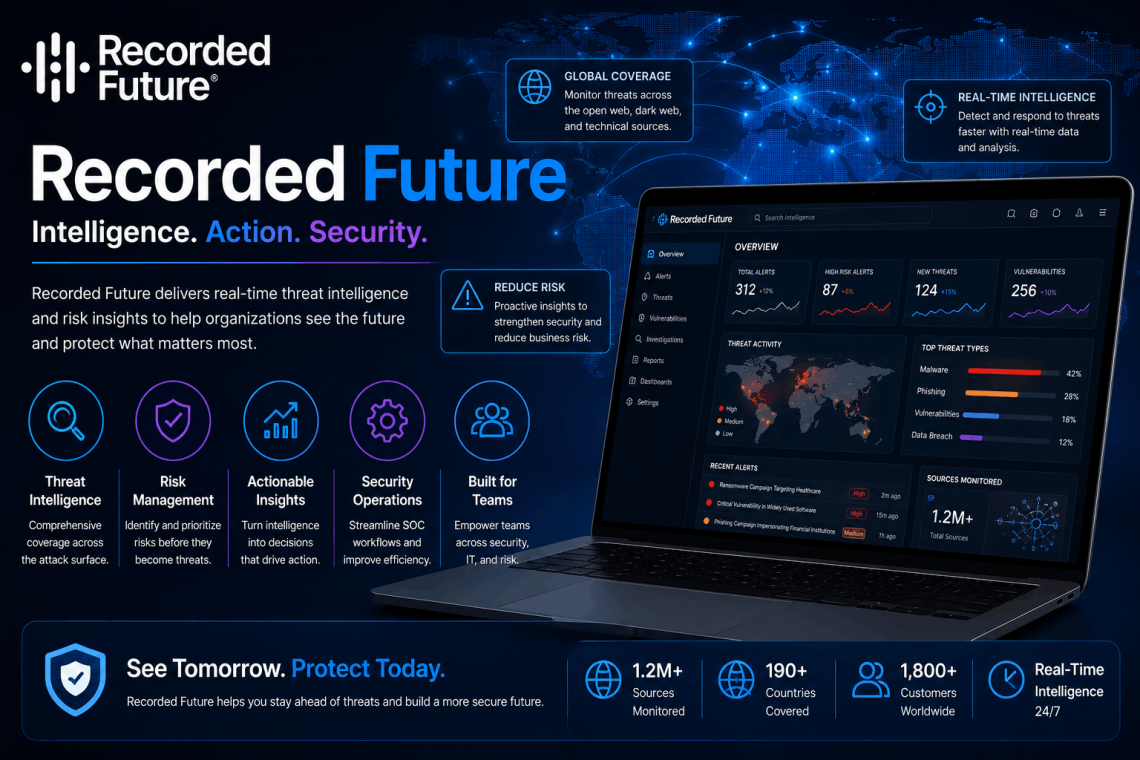
atory filings all contribute to Recorded Future’s intelligence picture. When a security researcher publishes a blog post about a newly observed malware technique, Recorded Future ingests and processes it.
Technical intelligence sources: Domain registration records, certificate transparency logs, IP geolocation and hosting data, BGP routing tables, passive DNS, and WHOIS data provide infrastructure-level visibility into how threat actors build and operate their attack infrastructure.
Dark web and underground forums: Recorded Future monitors criminal forums, paste sites, illicit marketplaces, and other closed communities where threat actors trade tools, share techniques, sell stolen credentials, and coordinate attacks. This source category is particularly valuable for early warning of targeted campaigns and data breach exposure.
Social media and messaging platforms: Twitter/X, Telegram channels, and other public social platforms are monitored for threat actor communications, vulnerability disclosures, and emerging campaign activity.
Proprietary and partner feeds: Recorded Future incorporates data from commercial threat feeds, government-shared intelligence, and information-sharing organizations (ISACs) to complement its own collection.
Machine Learning and NLP Processing
Raw collected data passes through Recorded Future’s analytical engine, which applies machine learning models and natural language processing to extract meaning and establish relationships.
The platform identifies entities threat actors, malware families, vulnerabilities, targeted industries, attack techniques, infrastructure components and maps the relationships between them. When a forum post mentions a specific ransomware group alongside a newly registered domain, Recorded Future’s models extract that relationship and incorporate it into the relevant intelligence records.
This automated analysis runs continuously, 24 hours a day, across millions of data points. The result is an intelligence graph that grows richer and more connected over time as new information is ingested and related to existing records.
Intelligence Scoring and Prioritization
One of the most practically useful features of Recorded Future is its risk scoring system. Rather than delivering raw data and expecting analysts to make prioritization decisions themselves, Recorded Future assigns risk scores to indicators, vulnerabilities, threat actors, and other entities based on observed evidence.
A vulnerability with a CVSS score of 7.5 might receive a Recorded Future risk score of 95 out of 100 if the platform observes active exploitation code being shared on criminal forums, references to the vulnerability in ransomware group communications, and multiple proof-of-concept exploits in public repositories. A different vulnerability with a higher CVSS score might receive a lower Recorded Future risk score if there is no observed exploitation activity in the wild.
This context-aware scoring helps security teams focus their patching, monitoring, and response efforts on the threats that actually matter right now . not just the ones that look threatening on paper.
Core Modules of the Recorded Future Platform
Recorded Future is organized into several intelligence modules, each focused on a specific threat intelligence use case. Organizations typically deploy the modules most relevant to their threat profile.
Threat Intelligence (TI) Module
The foundational module, Threat Intelligence provides access to Recorded Future’s full intelligence graph. Security analysts use it to:
- Research threat actors targeting their industry or geography
- Investigate indicators of compromise found during incident response
- Monitor emerging malware families and attack techniques
- Track vulnerability exploitation trends
- Build threat profiles for adversaries relevant to their organization
The TI module is the starting point for most threat intelligence workflows on the platform and integrates with security tools via the Recorded Future API.
SecOps Intelligence Module
The SecOps module is designed specifically for Security Operations Center (SOC) teams. It integrates directly with SIEMs, SOAR platforms, EDR solutions, and ticketing systems to deliver prioritized threat context directly into existing analyst workflows.
Key capabilities include:
- Automated alert enrichment: When a security alert fires in your SIEM, the SecOps module automatically enriches it with Recorded Future intelligence about the involved indicators is this IP address known to be associated with a threat actor? Has this domain been observed in malware campaigns? This context dramatically reduces the time analysts spend researching each alert.
- Playbook integration: Works with SOAR platforms like Splunk SOAR, Palo Alto XSOAR, and others to trigger automated response actions based on Recorded Future intelligence.
- Prioritized alert queue: Rather than delivering a flat list of alerts, the SecOps module surfaces the highest-risk events first based on Recorded Future risk scores.
Vulnerability Intelligence Module
For vulnerability management teams, Recorded Future’s Vulnerability Intelligence module provides a threat-informed view of the vulnerability landscape that goes far beyond what traditional vulnerability scanners deliver.
The module tracks:
- Active exploitation signals: Is this CVE being exploited in the wild right now, or is it just theoretically dangerous?
- Proof-of-concept availability: Has working exploit code been published? Where? How widely has it been shared?
- Threat actor adoption: Are specific ransomware groups or APT actors incorporating this vulnerability into their toolkits?
- Patch urgency scoring: A combined score that incorporates CVSS severity, exploitation evidence, and threat actor interest to help teams prioritize remediation
For organizations managing thousands of open vulnerabilities as most enterprises do this intelligence-driven prioritization is transformative. It focuses limited remediation resources where the actual risk is highest.
Brand Intelligence Module
Brand Intelligence monitors for threats to an organization’s external reputation and brand assets. This module is particularly valuable for financial services, retail, and consumer-facing organizations where brand impersonation and digital fraud are persistent threats.
Capabilities include:
- Domain spoofing detection: Monitoring for newly registered domains that impersonate your brand typically used for phishing campaigns, credential theft, or customer fraud
- Social media impersonation: Detecting fake social accounts that pose as your organization or executives
- Dark web brand mentions: Alerting when your organization’s name appears in criminal forum discussions which may indicate planned fraud, data leaks, or targeted attack planning
- Executive exposure monitoring: Tracking when your senior leaders’ names appear in threat actor communications
Early detection of brand threats allows organizations to take down malicious infrastructure before it is used to harm customers or employees.
Attack Surface Intelligence Module
The Attack Surface Intelligence module gives organizations a continuous, outside-in view of their own digital footprint the same view an attacker would have when researching a target.
This module discovers and monitors:
- Internet-facing assets and services, including ones that may not be formally tracked in internal inventories
- Exposed credentials and leaked data associated with your organization
- Vulnerable software versions running on external-facing systems
- Certificates nearing expiration or using weak cryptography
- Shadow IT and unmanaged assets that may carry risk
Many organizations are surprised by what the Attack Surface Intelligence module surfaces. Assets that internal teams had forgotten about old web servers, development environments left public-facing, acquired company infrastructure show up here with their associated risks clearly identified.
Recorded Future in Practice: Real-World Intelligence Workflows
Understanding the platform’s modules is one thing. Seeing how they fit together in real security workflows is where the value becomes concrete.
Incident Response Enrichment
During an active incident, time is the most critical resource. Analysts need to understand what they are dealing with is this a known threat actor? What are their typical tactics? Where have they been seen before? faster than manual research allows.
Recorded Future accelerates incident response by enabling analysts to paste an IP address, domain, file hash, or email address directly into the platform and receive an immediate intelligence report. That report shows:
- Whether the indicator has been observed in prior threat campaigns
- Which threat actors have used it
- What malware families it has been associated with
- What other infrastructure it is connected to
- A risk score with the evidence behind it
What might take an experienced analyst an hour of manual research across multiple sources takes seconds in Recorded Future. For a large incident with dozens of indicators to investigate, this speed difference is material.
Proactive Threat Hunting
Threat hunting proactively searching for attacker activity that has evaded automated detection benefits enormously from Recorded Future intelligence. Rather than hunting blindly, security teams can use Recorded Future to understand what tactics, techniques, and procedures (TTPs) specific threat actors are currently using and hunt for those specific patterns in their own environment.
For example: if Recorded Future intelligence indicates that a ransomware group active in your industry is currently using a specific Cobalt Strike configuration and staging infrastructure on a particular hosting provider, your threat hunters can search for that specific combination of indicators in your telemetry. This targeted approach is far more efficient than generic hunting and dramatically increases the likelihood of catching an intrusion before it becomes a breach.
Strategic Intelligence Briefings
Not all Recorded Future use cases are operational. Senior security leaders CISOs, security directors, and board-level stakeholders need strategic intelligence that helps them make resource allocation and risk management decisions.
Recorded Future’s analyst reports and custom briefing capabilities support this use case. The platform’s team of human analysts produces finished intelligence reports on topics like:
- Threat landscape assessments for specific industries
- Nation-state cyber activity targeting specific geographies
- Emerging ransomware groups and their targeting patterns
- Geopolitical developments and their cyber implications
These reports translate the raw intelligence data into strategic narratives that help security leaders communicate risk in terms that boards and executive teams understand.
Third-Party and Supply Chain Risk Monitoring
Supply chain attacks have become one of the most consequential categories of cyber risk. When attackers compromise a widely used software vendor or managed service provider, they gain access to that vendor’s entire customer base simultaneously.
Recorded Future enables organizations to monitor the threat posture of their critical third-party vendors the same way they monitor their own. By running Attack Surface Intelligence and threat monitoring against vendor domains and IP ranges, security teams can identify when a supplier is showing signs of compromise or exposure and take protective action before a downstream attack materializes.
Integrating Recorded Future with Your Security Stack
Recorded Future is most powerful when it is embedded in your existing security tools rather than operated as a standalone platform.
H3: SIEM Integration
Recorded Future integrates with major SIEM platforms including Splunk, Microsoft Sentinel, IBM QRadar, and Exabeam. The integration delivers threat intelligence enrichment directly into SIEM alert workflows, adding risk context to events as they are generated rather than requiring analysts to research context separately after the fact.
Configuration typically involves deploying a Recorded Future app or plugin within the SIEM platform and connecting it to Recorded Future via API key. Most major SIEM vendors maintain official integration documentation in partnership with Recorded Future.
H3: SOAR Platform Integration
For teams running Security Orchestration, Automation, and Response (SOAR) platforms, Recorded Future provides pre-built playbook components and API actions that allow automated intelligence enrichment and response triggering.
A common SOAR workflow using Recorded Future might look like this:
- Alert fires in SIEM for suspicious outbound connection
- SOAR playbook automatically queries Recorded Future API for the destination IP
- Recorded Future returns risk score of 85/100 with evidence of prior malware C2 use
- SOAR playbook automatically blocks the IP in the firewall and creates a high-priority ticket
- Analyst receives a pre-enriched ticket with full Recorded Future context, ready for investigation
This type of automated enrichment-and-response loop reduces mean time to respond (MTTR) and allows analysts to focus on genuinely complex investigations rather than routine indicator research.
H3: Firewall and EDR Integration
Recorded Future’s threat intelligence feeds can be ingested directly into firewall platforms, web proxies, and endpoint detection solutions to enable automated blocking of known malicious infrastructure. This turns intelligence into prevention rather than just detection.
Most enterprise security platforms support external threat intelligence feed ingestion in STIX/TAXII format, which Recorded Future supports natively. Configure your feeds to update on a schedule (every 15–60 minutes is common) to ensure your defenses reflect the most current intelligence.
Recorded Future vs. Competing Threat Intelligence Platforms
The threat intelligence market includes several strong competitors. Understanding where Recorded Future fits helps organizations make informed platform decisions.
H3: Recorded Future vs. Mandiant Advantage
Mandiant (now part of Google Cloud) brings exceptional frontline incident response and malware analysis expertise to its intelligence platform. Mandiant’s strength lies in deep, human-analyst-driven intelligence from active incident response engagements.
Recorded Future’s strength lies in breadth, automation, and speed. Its machine learning-driven collection processes vastly more data points than any human analyst team, and its integrations with security tooling are more extensive. Organizations that need high-volume automated enrichment integrated into SOC workflows tend to favor Recorded Future; those that need deep, bespoke threat actor analysis often value Mandiant’s human analyst depth.
H3: Recorded Future vs. CrowdStrike Falcon Intelligence
CrowdStrike’s intelligence offering is tightly integrated with its own endpoint detection and response platform. For organizations already heavily invested in the CrowdStrike ecosystem, Falcon Intelligence provides a convenient, well-integrated intelligence layer.
Recorded Future, by contrast, is platform-agnostic. It integrates with the full spectrum of security tools regardless of vendor, which makes it a better fit for organizations with heterogeneous security stacks or those that want intelligence independent of any single vendor’s endpoint perspective.
H3: Recorded Future vs. MISP and Open-Source Alternatives
Open-source threat intelligence platforms like MISP (Malware Information Sharing Platform) offer a no-cost starting point for organizations building their first threat intelligence program. MISP is powerful for sharing indicators within trusted communities and integrating manual analysis workflows.
The tradeoff is scale and automation. MISP relies on community contributions and manual analyst input. Recorded Future’s continuous automated collection, processing, and scoring across billions of data points is simply not replicable with open-source tooling . at least not without a substantial dedicated engineering investment. Organizations typically graduate from open-source tools to Recorded Future as their threat intelligence program matures and their intelligence requirements grow more demanding.
Building a Threat Intelligence Program Around Recorded Future
Technology is only part of the equation. Organizations that extract the most value from Recorded Future pair the platform with a structured intelligence program.
H3: Define Your Intelligence Requirements
Before deploying Recorded Future, document what questions you actually need intelligence to answer. Common intelligence requirements include:
- Which threat actors are targeting our industry and geography?
- Are our executives’ credentials exposed in any known data breaches?
- Which unpatched vulnerabilities in our environment are being actively exploited by attackers?
- Is our brand being impersonated in phishing campaigns?
- Are any of our third-party vendors showing signs of compromise?
These requirements guide which Recorded Future modules to deploy, which alerts to configure, and how to measure the program’s value over time.
H3: Establish an Intelligence Consumption Workflow
Intelligence that is collected but not acted on provides no value. Build a defined workflow for how Recorded Future intelligence flows into your security operations:
- Who receives Recorded Future alerts and what is their response SLA?
- How does vulnerability intelligence flow into your patch management process?
- Who is responsible for acting on brand intelligence alerts?
- How is strategic intelligence shared with senior leadership?
These workflow decisions determine whether Recorded Future becomes a core operational tool or an expensive dashboard that no one checks.
H3: Measure Intelligence Program Effectiveness
Track metrics that demonstrate how Recorded Future intelligence is improving security outcomes:
- Mean time to detect (MTTD): Has threat intelligence shortened how long attackers dwell in your environment before detection?
- Patch prioritization accuracy: Are you patching vulnerabilities that get exploited, while deferring those that do not?
- Alert enrichment rate: What percentage of SIEM alerts are being enriched with Recorded Future context, and how much time does that save analysts?
- Brand threat takedowns: How many malicious domains, fake accounts, or phishing pages has Brand Intelligence enabled you to take down?
These metrics tell the story of intelligence program value in terms that justify continued investment and guide program improvement.
Recorded Future for Different Types of Organizations
Recorded Future is not a one-size-fits-all deployment. Different organization types use the platform in distinct ways.
H3: Enterprise Security Operations Centers
Large enterprise SOCs typically deploy Recorded Future as a central intelligence hub, integrating it with their SIEM, SOAR, and EDR platforms for automated enrichment across a high-volume alert environment. The ROI in this context comes from analyst efficiency . reducing the time each analyst spends on indicator research by automating the routine lookups, freeing them for complex, judgment-intensive investigations.
Financial Services Organizations
Banks, asset managers, payment processors, and insurance companies face a threat landscape that includes sophisticated fraud operations, nation-state actors interested in financial system disruption, and persistent targeting by organized criminal groups. Recorded Future’s Brand Intelligence, dark web monitoring, and financial sector-specific threat reporting make it particularly well-suited to this vertical.
Government and Public Sector
Government agencies at federal, state, and local levels use Recorded Future for both defensive intelligence and broader situational awareness around threats to critical infrastructure, election systems, and public services. Recorded Future’s compliance with government data handling requirements and its established presence in public sector contracting vehicles makes it accessible for government procurement.
Managed Security Service Providers (MSSPs)
MSSPs that provide security operations services to multiple clients use Recorded Future to power threat intelligence capabilities they deliver as part of their service offering. Recorded Future’s multi-tenant architecture and API-first design support MSSP use cases, and its breadth of coverage helps MSSPs deliver intelligence-informed services across diverse client industries and geographies.
Getting Started with Recorded Future
For organizations evaluating Recorded Future, the path to deployment typically follows a few standard steps.
Request a demo or trial: Recorded Future offers demonstrations and proof-of-concept trials. Use the trial period to test the specific intelligence modules most relevant to your threat profile . do not evaluate generic functionality when your actual concern is, for example, vulnerability intelligence for your specific technology stack.
Identify your integration priorities: Before go-live, map out which security tools you want to integrate with Recorded Future and in what order. Start with the integration that will generate the most immediate analyst time savings . usually SIEM enrichment for active SOC teams.
Train your analyst team: Recorded Future provides training resources and certification programs. Analysts who understand how the intelligence is produced and how to interpret risk scores and evidence chains will extract far more value from the platform than those who treat it as a black box.
Build your alert configuration thoughtfully: More alerts are not always better. Configure Recorded Future alerts around your documented intelligence requirements . the specific questions your organization needs answered. A well-tuned alert profile generates actionable notifications; a poorly tuned one creates noise that analysts start to ignore.