Meta Description: Everything you need to know about the T-Phone 3 specs, camera quality, battery life, performance, and how to get the most out of T-Mobile’s latest mid-range 5G smartphone.
T-Phone 3: The Complete Guide to Better Features and Performance
Meta Description: Everything you need to know about the T-Phone 3 specs, camera quality, battery life, performance, and how to get the most out of T-Mobile’s latest mid-range 5G smartphone.
What Is the T-Phone 3 and Who Is It For?
T-Mobile’s T-Phone 3 landed in August 2025 as one of the more intriguing mid-range 5G smartphones of the year. Built on the Qualcomm Snapdragon 6 Gen 3 chipset, shipped with Android 15, and priced starting at around $174, it positions itself squarely in the budget-to-mid-range category offering features that punch above its price point for everyday users.
If you’re on T-Mobile’s network and want a capable 5G phone without spending flagship money, the T-Phone 3 deserves serious consideration. It brings a large 6.58-inch 120Hz display, a 5000mAh battery, a 50MP main camera with OIS, and a software commitment of up to three major Android OS upgrades. For a phone at this price, that spec sheet is genuinely competitive.
This guide covers everything from the hardware design and display quality to real-world camera performance, battery behavior, software features, and practical tips for getting the best out of your T-Phone 3. Whether you’re deciding whether to buy it or have already picked one up, this is the reference you need.
T-Phone ; 3 Full Specifications at a Glance
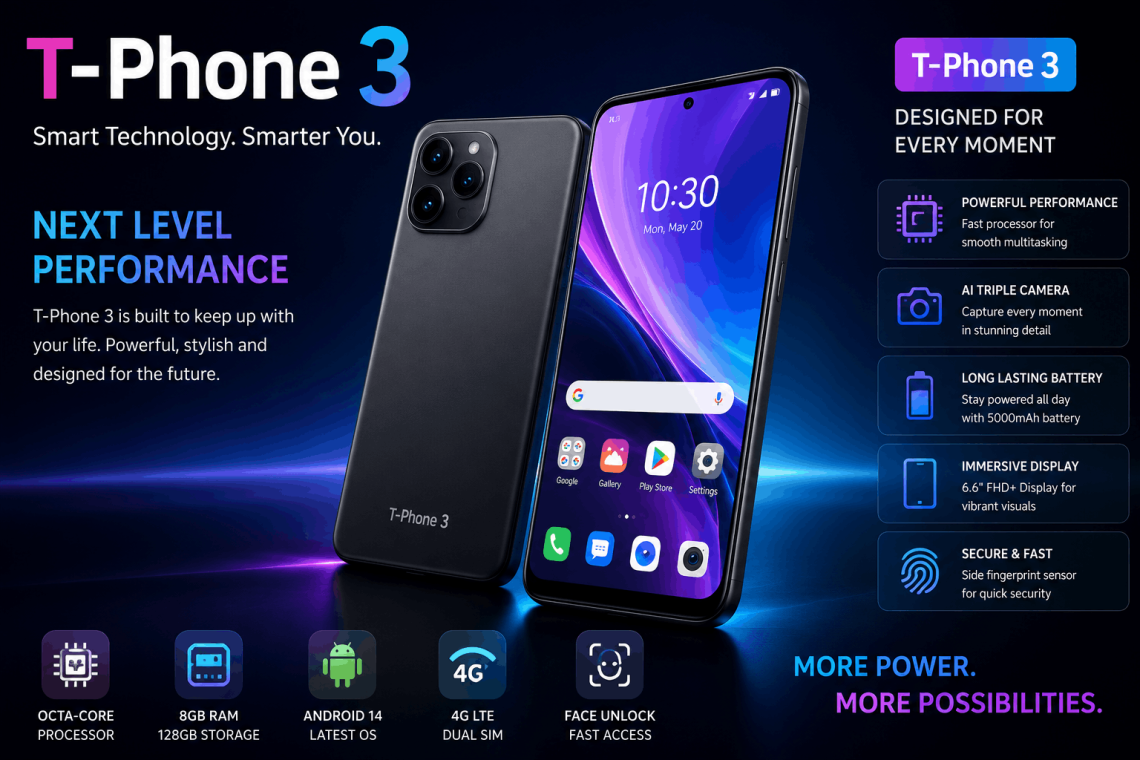
Before getting into the details, here’s the complete spec sheet so you can quickly reference any aspect of the device:
- Display: 6.58-inch IPS LCD, 1080 x 2408 pixels (~401 ppi), 120Hz refresh rate
- Chipset: Qualcomm SM6475-AB Snapdragon 6 Gen 3 (4nm)
- CPU: Octa-core (4×2.4 GHz Cortex-A78 + 4×1.8 GHz Cortex-A55)
- GPU: Adreno 710
- RAM: 6GB
- Storage: 128GB, expandable via microSDXC
- Rear cameras: 50MP (main, OIS) + 2MP (depth)
- Front camera: 13MP
- Battery: 5000mAh Li-Po, non-removable, 25W fast charging
- OS: Android 15 (up to 3 major OS upgrades)
- Connectivity: 5G (n1/n3/n7/n28/n38/n75/n78), Wi-Fi 5, Bluetooth 5.x, NFC, USB-C
- Security: Side-mounted fingerprint scanner
- Build: IP54 dust and water resistance
- Dimensions: 166.5 x 77.1 x 9.3mm
- Weight: 218g
- Price: Starting at approximately $174 (T-Mobile exclusive)
Design and Build Quality
How the T-Phone 3 Feels in Hand
At 218 grams and 9.3mm thick, the T-Phone 3 is not a lightweight phone. Pick it up expecting substance this is a phone with a solid, sturdy feel rather than a featherweight experience. The dimensions (166.5 x 77.1 x 9.3mm) place it firmly in the large-phone category, so one-handed use is limited for smaller hands.
The IP54 certification is a meaningful real-world feature at this price tier. It means the T-Phone 3 is protected against dust ingress and can handle splashes and light rain without drama. You won’t want to submerge it, but accidental drops in puddles or caught-in-the-rain situations are handled comfortably.
The side-mounted fingerprint scanner is well-positioned and reliable in day-to-day use. Combined with face unlock, getting into the phone is fast and rarely frustrating.
The T-Phone 3 Pro Variant
It’s worth noting that a T-Phone 3 Pro variant also exists, offering an upgraded AMOLED 6.80-inch display, 8GB RAM, 256GB storage, and a triple rear camera system (50MP main + 13MP ultrawide + 2MP macro). For users who want the bigger display and extra RAM headroom, the Pro is worth the additional investment. This guide focuses primarily on the standard T-Phone 3, though most software and performance observations apply to both.
Display: What to Expect from the 6.58-Inch Screen
Panel Quality and Sharpness
The T-Phone 3 uses an IPS LCD panel not AMOLED, which is a tradeoff worth understanding. IPS LCD typically delivers accurate, consistent colors with good brightness in daylight, but it can’t match the deep blacks or power efficiency of AMOLED in dark conditions.
At 1080 x 2408 resolution with a pixel density of ~401 ppi, the screen is sharp. Text is crisp, images look detailed, and there’s no perceivable pixelation in normal use. The 120Hz refresh rate keeps scrolling and animations feeling fluid, which is one of the best upgrades you get compared to budget phones that cap at 60Hz.
Users have noted the screen holds up well in direct sunlight visibility in bright outdoor conditions is solid for a phone at this price.
The 120Hz Refresh Rate: A Known Issue to Watch
Real-world user reports have flagged an intermittent flickering bug related to the 120Hz mode. This appears to be a software issue rather than a hardware defect, and the Android 16 update (which rolled out to the T-Phone 3 as a 2.68GB update) reportedly addressed most lag and display-related issues. If you’re seeing display flicker, updating to the latest software version is the first step.
Performance: Snapdragon 6 Gen 3 in Practice
Chipset Deep-Dive
The Snapdragon 6 Gen 3 (built on TSMC’s 4nm process) is a capable mid-range chipset. The octa-core CPU configuration \ four Cortex-A78 performance cores at 2.4GHz and four Cortex-A55 efficiency cores at 1.8GHz handles the demands of everyday use without breaking a sweat. Browsing, social media, streaming, light photo editing, and most mobile gaming run smoothly.
The Adreno 710 GPU holds up for casual to moderate gaming. Titles like Call of Duty Mobile and Genshin Impact run at medium to high settings, though intensive graphic settings may introduce occasional frame drops in the most demanding scenes.
Most user accounts describe performance as strong for the price bracket, with post-Android 16 update reports specifically noting that lag issues present at launch were largely resolved.
RAM and Storage Management
With 6GB of RAM, the T-Phone 3 manages multitasking capably. Switching between a handful of apps stays smooth, and apps stay resident in memory for a reasonable amount of time before needing a fresh load. Power users running many background processes simultaneously may feel some limitations compared to 8GB devices, but for the target audience, it’s more than adequate.
The 128GB internal storage is expandable via microSDXC, which is an important practical advantage. If you shoot a lot of photos or download media for offline use, a microSD card is a worthwhile add-on purchase.
Camera System: Real-World Performance
Main Camera: 50MP with OIS
The 50MP main camera is the star of the T-Phone 3’s camera system. Optical Image Stabilization (OIS) at this price point is genuinely rare and makes a noticeable difference in two scenarios: low-light photos and video recording stability. OIS compensates for hand tremor during longer exposures, resulting in sharper handheld shots in dim environments than you’d typically expect from a budget device.
Daylight performance is good. Colors are accurate in natural light, detail is solid, and the 50MP sensor gives you flexibility to crop into shots without significant quality loss.
Camera Software: The Honest Picture
The camera hardware tells only part of the story the software that processes images shapes the final result just as much. T-Phone 3 user reports highlight a few specific quirks with the stock camera app:
Darker, sharper processing style: The default camera app tends toward darker exposures with heavier sharpening. This look works well for some subjects (architecture, landscapes) but can feel less natural for portraits or casual shots.
Audio recording inconsistencies: Some users have reported the camera occasionally capturing video in mono sound rather than stereo a bug rather than a design choice. Additionally, the microphone is highly sensitive, which creates problems when recording near traffic or other loud ambient noise. Videos shot on busy streets can come out with heavy background noise amplification.
The GCam fix: A commonly recommended workaround is installing a Google Camera (GCam) port. Users who’ve made this switch consistently report significantly better results improved color processing, better dynamic range, and more consistent exposure. The stock app isn’t worthless, but GCam unlocks noticeably better output from the same hardware.
Front Camera: 13MP Selfies
The 13MP front camera performs well in good light. Skin tones are handled reasonably, and detail is sharp enough for social media and video calls. Low-light selfie performance is average workable but not a highlight of the phone.
Video Recording Capabilities
The T-Phone 3 supports video recording up to 1440p@30fps and 1080p at 30fps and 60fps. The OIS helps with video stabilization, and users have noted surprisingly stable footage for a phone without electronic image stabilization (EIS) as a primary feature. For most everyday video needs capturing family moments, travel footage, content creation at a basic level the output is respectable.
Battery Life: What the Numbers Actually Mean
5000mAh Capacity in Daily Use
The T-Phone 3’s 5000mAh battery is one of its genuinely strong points. On typical daily use browsing, social media, music, some navigation, and moderate camera use over Wi-Fi most users comfortably get through a full day with charge to spare.
Real-world screen-on time (SOT) figures from user testing show a range from around 4 hours on heavy 5G data usage to up to 8 hours of SOT on lighter use patterns. The heavy 5G data scenario is worth understanding: when the phone is pulling data over 5G continuously (especially on a weaker signal inside a building), battery consumption increases substantially. If you’re doing data-intensive tasks on cellular regularly, expect battery life in the 4–5 hour SOT range.
For moderate users sticking mostly to Wi-Fi for data, the T-Phone 3 is a reliable all-day phone with room to spare.
25W Fast Charging
The included 25W fast charging support means you can get meaningful charge back quickly when needed. While this doesn’t match the 65W or 100W+ charging found on some higher-priced phones, it’s faster than the 15–18W that many budget phones offer. A 30-minute charge session from low battery gets you to a comfortable level for continuing the day.
Tips to Maximize Battery Life on the T-Phone 3
A few practical adjustments help preserve battery on this device:
- Use Adaptive Refresh Rate mode rather than locking to 120Hz constantly. The 120Hz refresh rate increases battery draw, and most tasks (reading, email, browsing) don’t need it.
- Limit 5G to when you actually need it. Toggling to LTE for daily browsing and reserving 5G for downloads or streaming reduces background power draw.
- Enable the Ultra Power Saving mode during long days when charging isn’t available. It limits background app activity and display brightness while keeping calls and messages accessible.
- Reduce screen brightness. The IPS display at high brightness is one of the larger battery consumers.
Software: Android 15 and the Update Promise
Android 15 Out of the Box
The T-Phone 3 ships with Android 15, which brings material improvements to notification management, privacy controls, and system performance. T-Mobile’s version includes some carrier-specific apps, but the software experience stays close to stock Android . a welcome contrast to the heavily skinned alternatives in this price range.
The Android 16 update has already rolled out to the T-Phone 3, arriving as a 2.68GB package that addressed lingering performance and display bugs from the Android 15 launch version. If you haven’t updated yet, doing so is the single best thing you can do for day-to-day performance and display stability.
Three Major OS Upgrades: Why This Matters
T-Mobile’s commitment to three major Android OS upgrades for the T-Phone 3 is a significant differentiator at this price. Many budget phones receive one or two updates before support ends. Getting three means the T-Phone 3 you buy today stays current with new features, performance improvements, and security patches through 2028 at minimum.
For buyers who keep phones for multiple years (which is most people buying at this price point), the longevity commitment is genuinely valuable.
Privacy and Security Features
The T-Phone 3 includes several noteworthy privacy features carried over from Android 15: on-device machine learning for photo recognition that keeps sensitive data on the device rather than uploading to cloud servers, clipboard access alerts when an app reads your clipboard, approximate location sharing (giving apps your general area rather than precise location), and camera/microphone usage indicators.
These aren’t unique to the T-Phone 3, but they’re worth knowing about and using consciously.
Connectivity: 5G, Wi-Fi, and More
5G Performance
5G reception and speed is one of the T-Phone 3’s clear strengths. Users consistently praise the 5G experience, noting fast speeds and strong signal in coverage areas. The phone supports 5G bands n1, n3, n7, n28, n38, n75, and n78 covering the main sub-6GHz bands used by T-Mobile’s network.
Note that the T-Phone 3 is a T-Mobile exclusive. Users on Verizon cannot use this device on their network, so network compatibility is the primary purchase qualifier.
Wi-Fi 5 and Bluetooth
The T-Phone 3 supports Wi-Fi 5 (802.11ac) rather than the newer Wi-Fi 6 or 6E. For most users, this is inconsequential Wi-Fi 5 handles streaming, browsing, and downloads at home without limitation. If you’re in a crowded Wi-Fi environment (dense apartment buildings, offices with many connected devices), Wi-Fi 6 would offer better efficiency, but for the target audience, Wi-Fi 5 is entirely functional.
NFC support is present, enabling contactless payments via Google Pay and similar services.
No Headphone Jack
The T-Phone 3 Pro variant does not include a 3.5mm headphone jack. If wired audio is important to you, factor in the cost of a USB-C to 3.5mm adapter or plan for Bluetooth headphones. The standard T-Phone 3 situation should be verified at purchase, as this varies between variants.
T-Phone 3 vs. The Competition
At the $174–$220 price range, the T-Phone 3 competes with a field of capable mid-range Android devices. Here’s how it stacks up on the key considerations:
- Moto G Power series: The Moto G Power phones have historically dominated battery life in this segment. The T-Phone 3 matches them closely on capacity (both at 5000mAh), while offering faster charging and a higher-resolution main camera. Moto often wins on software cleanliness and wider carrier compatibility.
- Samsung Galaxy A series (A15/A25 range): Samsung’s A-series brings brand recognition and reliable software support. The T-Phone 3 holds its own on camera hardware (OIS is a distinct advantage) and offers comparable display quality at a competitive price. Samsung’s longer track record of software updates gives it an edge in reliability confidence.
- Pixel 7a (used/refurbished): At slightly higher price points in the refurbished market, the Pixel 7a offers Google’s best-in-class computational photography and guaranteed OS updates. If camera quality is the top priority, a refurbished Pixel 7a is worth the comparison. The T-Phone 3 wins on new device warranty, battery capacity, and current software version.
The T-Phone 3’s clearest advantages are its OIS main camera at this price, the 120Hz display, IP54 certification, and the three-major-update software commitment features that typically cost more elsewhere.
Tips for Getting the Best Performance from Your T-Phone 3
Optimize the Camera Output
- Install a GCam port for noticeably improved photo and video processing. The default camera app works, but GCam unlocks the hardware’s fuller potential.
- When recording video near busy roads or loud environments, use a post-processing app with noise reduction (the stock microphone is highly sensitive and picks up ambient sound aggressively).
- Shoot in Pro mode for manual control over exposure if the auto mode’s darker-exposure tendency doesn’t suit a particular scene.
Keep the Software Updated
The Android 16 update resolved most of the performance and display issues reported on launch. Check for updates in Settings → System → System Update and install promptly when available.
Manage Storage Proactively
128GB fills faster than expected once you account for apps, photos, and downloaded media. Pick up a microSDXC card early and configure the camera to save photos directly to the card.
Use the Fingerprint Scanner Consistently
The side-mounted fingerprint scanner is fast and accurate once it has a well-trained fingerprint. Register the same finger two to three times (treating them as separate entries) to improve recognition speed in various grip positions.
Who Should Buy the T-Phone 3?
The T-Phone 3 makes the most sense for:
T-Mobile subscribers on a budget who want a genuine 5G smartphone without paying flagship prices. At $174, the combination of Snapdragon 6 Gen 3, 120Hz display, OIS camera, and IP54 protection is genuinely hard to match.
Users upgrading from older mid-range phones who want a noticeable step up in performance without a major financial commitment.
People who prioritize longevity the three-major-OS-upgrade commitment means this phone stays supported and relevant for years, not just months.
Moderate to light smartphone users who want a reliable daily driver for calls, messaging, social media, and occasional photography without demanding high-end gaming performance or flagship camera quality.
It’s less suited for heavy gamers who need top-tier GPU performance, photography enthusiasts who demand the best computational camera processing, or users on networks other than T-Mobile.
Final Verdict: Is the T-Phone 3 Worth It?
The T-Phone 3 is a well-constructed mid-range device that gets the fundamentals right. It has a large, smooth display, solid 5G performance, a capable OIS camera, reliable all-day battery life, and a meaningful software update commitment all at a price that leaves room in the budget for accessories, a protective case, and a microSD card.
Its weaknesses are real but manageable: the stock camera app’s processing style benefits from GCam, the weight and size aren’t for everyone, and the 5G battery drain under heavy load is worth knowing about. None of these are dealbreakers; they’re factors to factor in.
For T-Mobile subscribers looking for a capable, future-proofed 5G smartphone under $200, the T-Phone 3 earns a strong recommendation. It delivers genuine value at its price point, and with the Android 16 update already landed, the early software roughness is behind it.